


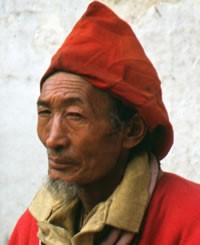

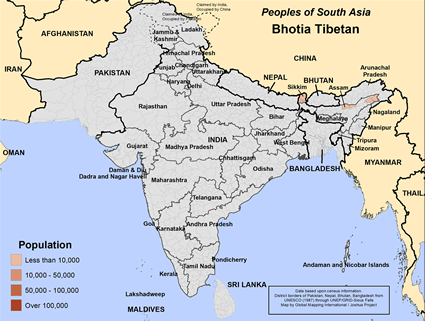
The Tibetan Bhotia in India live in the high Himalayan borderlands of northern India—primarily in parts of Uttarakhand, with related populations in Himachal Pradesh and Sikkim—and their main language is Sikkimese. The speak Sikkimese.
Historically groups labeled Bhotiya or Bhotia engaged in trans Himalayan trade, seasonal pastoralism, and valley based agriculture; distinct valley subgroups (for example Johari, Marchha, Tolcha, Byansi and others) developed local social structures and clan identities. The closure of the Indo Tibetan border in the mid 20th century disrupted traditional trade routes and contributed to economic shifts that affected livelihoods and mobility.
Traditional livelihoods combined seasonal migration and transhumant pastoralism with trade across Himalayan passes; many communities practiced small scale agriculture and animal husbandry adapted to high altitude valleys. Settlement patterns concentrate in upper river valleys where terrain and seasonality limit year round access to services. Since the mid 20th century economic change, some communities have diversified into the collection and trade of medicinal and aromatic plants, wage labor, tourism related work, and migration to lower altitude towns.
Social organization is often valley centered, with customary councils and clan networks managing marriage, resource use, and dispute resolution. Access to infrastructure, markets, and public services varies widely by valley and season.
Religious life among Bhotia groups is diverse and varies by subgroup; many practice forms of Tibetan Buddhism, while others incorporate Hindu devotional practices and local shamanic or animistic customs. Ritual repertoires and religious institutions reflect historical ties to Tibetan culture alongside integration with broader Himalayan religious contexts.
Documented community needs include sustainable livelihood support that respects traditional ecological knowledge, improved access to healthcare and education in remote valleys, and infrastructure to reduce seasonal isolation. Post trade economic pressures and out migration have increased the need for locally tailored development interventions that support cultural continuity and economic resilience. Local assessments are required to identify priorities for specific valley subgroups.
Pray for the Lord to thrust out loving and dedicated Christian workers to take the abundant life of Jesus Christ to the Bhotia community in India.
Pray for improved access to healthcare and for practical support for families facing medical challenges.
Pray for expanded educational and vocational opportunities for children and youth, and for those in government and local leadership to make wise and just decisions that benefit the community.
Pray for preservation of Bhotia languages and valley cultural knowledge and for sustainable stewardship of their fragile mountain environment and natural resources.
Scripture Prayers for the Bhotia Tibetan in India.
Bhotiya — Wikipedia.
Tribal Research Institute & Training Centre, Government of Sikkim — Bhutia/Bhotiya community overview.
Manual of the Sikkim Bhutia language (D jong K), Graham Sandberg, Archive.org.
| Profile Source: Joshua Project |



